The Hidden Copywriting Opportunity Most Brands Ignore: The Shopping Bag
Procrastination has a habit of leading me into the murky waters of LinkedIn. Every now and then, however, something interesting rises to the surface of my news feed. Usually a small marketing debate or an unexpected comment thread, sparking the beginnings of an article.
That’s when I came across this post from the LinkedIn account, Famous Campaigns:
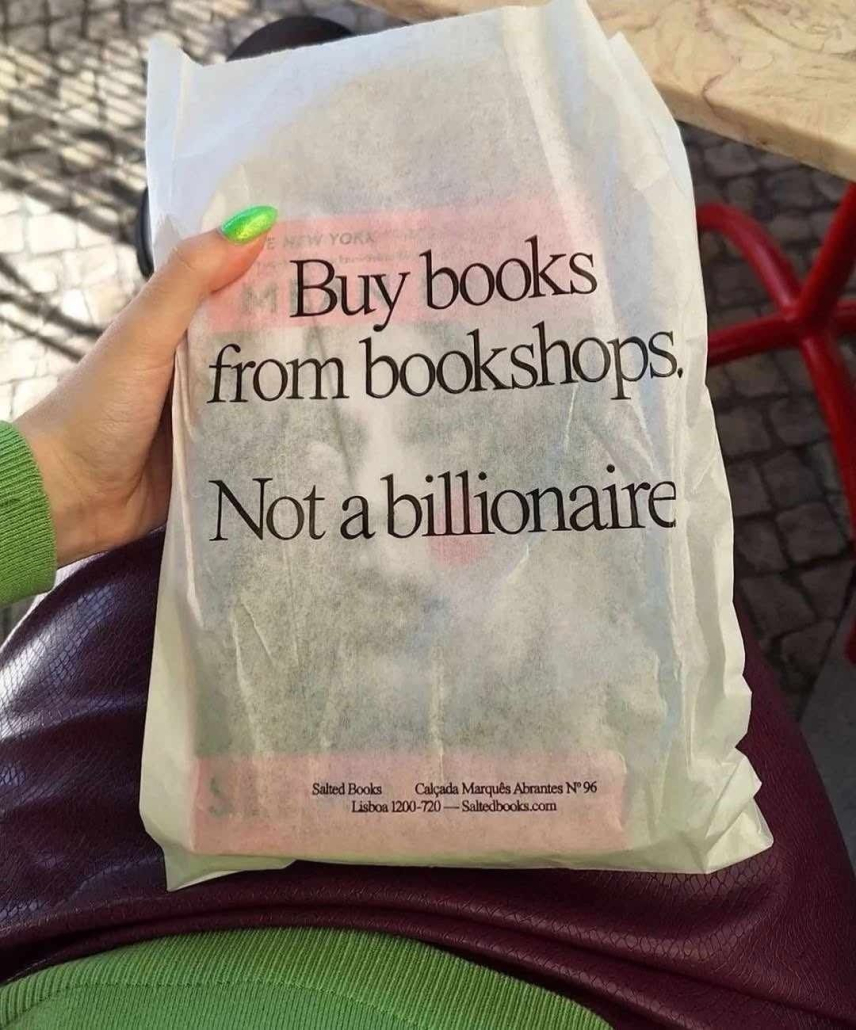
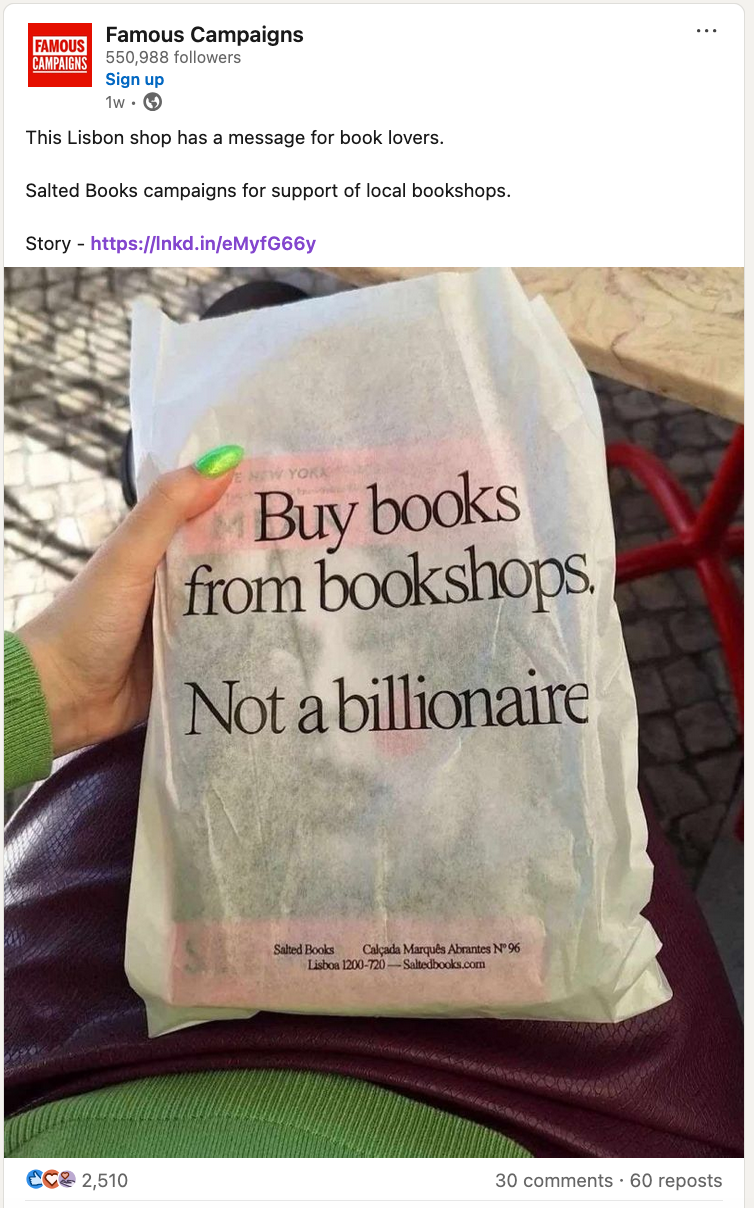 As a copywriter, my first instinct was to tweak the sentences so it reads, “Buy books from bookshops, not from Billionaires.” For the sake of the flow. Then I clicked the link that led to an article by James Herring, who discusses this exact nuance, likely knowing full well that copywriters everywhere (particularly the copywriters at Copywriter Collective) are having heart-palpitations over the clunky cadence printed on the side of the shopping bag.
He does go on to explain in his article that this was, in fact, purposeful: “A post from the store Instagram reads ‘We know this sentence can read a little awkwardly, your brain wants to finish it with ‘billionaires’. Plural. But here’s the thing, there is only one company making billions from books. And it’s not us or your local bookshop. It’s not even your local chain store. So forgive us for the awkward syntax. Makes a great bag though right?’”
Great, problem solved. I can now get on with my day.
Alas, like any respectable procrastinator, I turned to the comments’ section. Worryingly, several readers argued there was nothing wrong with supporting the billionaire in question. Quite how they arrived at that conclusion is a question best left for another article.
Table of Contents
The Copywriting Question Hidden in the Comments.
Leaving the billionaire defense squad to their own devices, one comment raised a far more interesting point about brand copywriting:
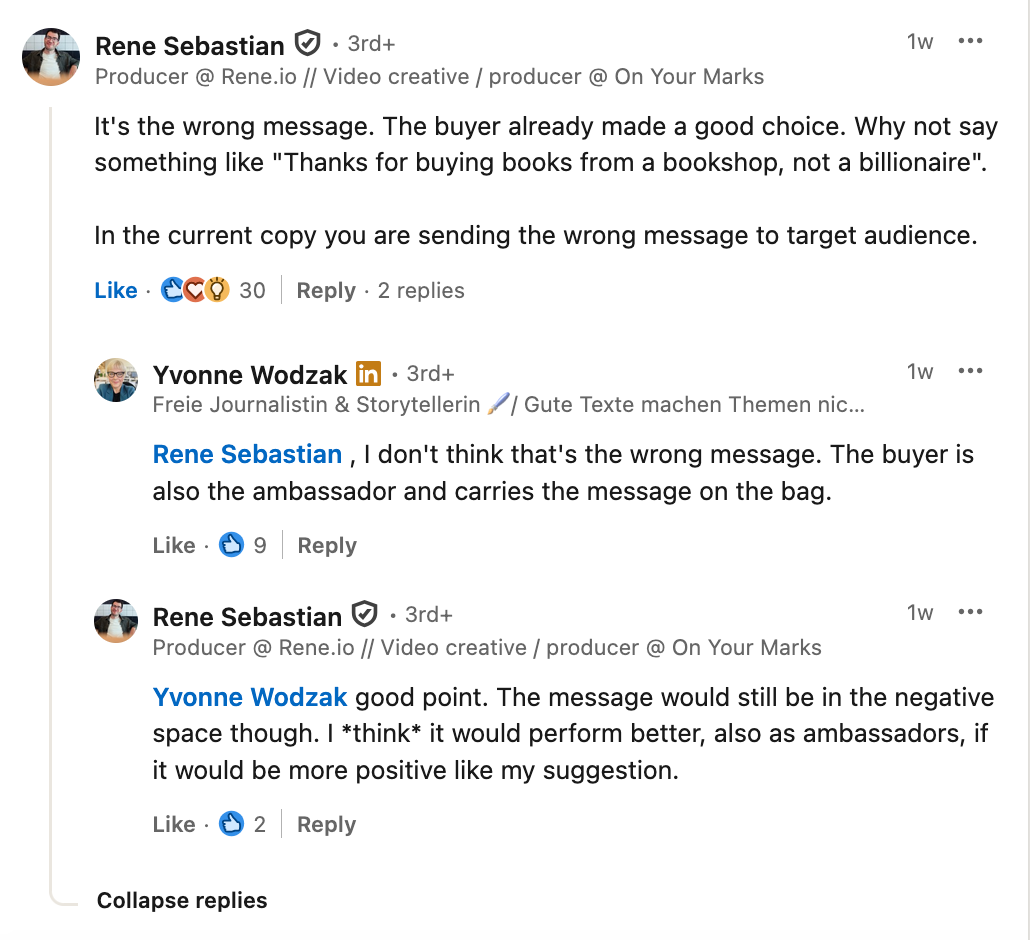
“It’s the wrong message. The buyer already made a good choice. Why not say something like “Thanks for buying books from a bookshop, not a billionaire”.
In the current copy you are sending the wrong message to [the] target audience.”
Ahaha, the conversation has now moved to the point-of-purchase and recognising where the customer is in their journey. When someone has already made a purchase, the role of the message is not to persuade but to affirm the decision they’ve just made. If the tone misses this moment, it risks alienating the very audience it should be strengthening a relationship with. A line such as “Thanks for buying books from a bookshop, not a billionaire” acknowledges the customer’s values and reinforces the reason they chose that retailer in the first place.
And with this, effective copy meets the audience where they are. It should reflect their motivations, and turns a simple transaction into a shared point of identity and loyalty.
It’s all about meeting the audience at the correct stage of the journey…
Which brings me to the next leg of the journey in this discussion.
The Counterargument: The Buyer Is Also the Media Channel.
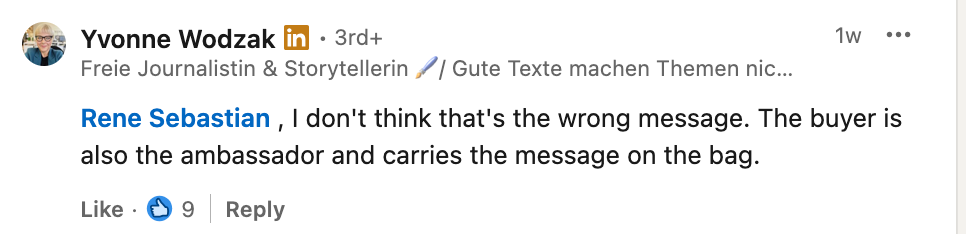
“The buyer is also the ambassador and carries the message on the bag.”
Now I’m invested.
The shopping bag is no longer packaging but additional, mobile advertising. Once it leaves the shop it travels through streets, cafés, trains, offices and libraries, quietly accumulating impressions along the way. There’s arguably a subtle advantage that comes along with this, the ad is removed from our phones and is part of real life. It’s not lost in internet noise, competing with countless brands for attention. It’s catching the eye of the few who happen to be within the shop’s vicinity, people sharing the same street, local cafés and businesses.
The book shop has effectively turned the customer into a distribution channel and the bag becomes a piece of earned media, carried through the city by someone who has already chosen to associate themselves with the brand.
The Overlooked Advertising Space.
There’s a clear missed opportunity for most brands who tend to treat their shopping bags as an afterthought. It’s a piece of practical logistics and at most, at best a surface for visual branding, printing their logo on the side. What they rarely treat them as is copy space.
A bag operates differently from almost every other advertising format in the retail sector. It has high visibility, people instinctively notice what others are carrying. It benefits from long exposure and it carries implicit endorsement, because someone has already chosen to hold it in public.
The Two Audiences Problem.
This is where the real nuance lies.
A shopping bag speaks to two audiences at once. First, the buyer, someone who has already chosen the brand and is no longer looking to be persuaded, but affirmed. The tone here should reward the decision, reinforce values and make the customer feel aligned with what they’ve supported.
At the same time, the bag is visible to the street, an audience that has not yet made that choice and needs a reason to care. This is where persuasion comes in. The challenge, and the opportunity, is to write copy that does both.
Good copy validates the buyer while remaining compelling to everyone else who happens to read them.
When a Bag Becomes a Cultural Signal.
In an increasingly polarised and socially aware landscape, consumers are becoming more conscious of the brands they choose to buy from and what those choices say about their values. Shopping second-hand versus buying from a high-street brand like Zara, for example, carries different cultural signals.
A shopping bag becomes more than something you carry purchases in. We see it in tote bags, political slogans, museum merchandise, and independent bookshops, all quietly communicating taste, values, and a sense of belonging. What someone carries can suggest where they stand, culturally or even politically. At that point, the bag stops functioning as just packaging and becomes packaging as marketing. It becomes a statement, a piece of brand messaging willingly carried through public space.
What Copywriters Should Learn From A Shopping Bag.
Copywriters spend enormous amounts of time refining ads, landing pages, and full-scale campaigns. Entire strategies are built around digital touchpoints, optimised for clicks, conversions, and scroll behaviour. Yet the physical moments where brands exist in public space are often overlooked.
This shopping bag from an independent book store in Lisbon is an example of one of those moments.
Shopping bags sit outside the algorithm and don’t compete with endless feeds or disappearing attention spans.
Great bag copy should do a few things well. It should reward the buyer, affirming the choice they have already made. It should express the brand’s values clearly and without excess. It should invite curiosity from those who happen to see it and ultimately, it should be concise enough to land at a glance.
A shopping bag is one of the few retail marketing assets that speaks simultaneously to the customer and the public, which makes the copy on it far more important than most brands realize.
About the Author
Ignore the ‘procrastination’ talk, it’s all in jest. With over 15 years of experience, Heather has never missed a deadline. If you want copy that works beyond the obvious, right down to the bag your customer carries, contact Copywriter Collective and hire Heather for your next retail revamp.
