5 Creative Tensions That Become Idea Engines
Every creative copywriter has a particular work flow that allows them to produce their best work. This could be a clear desk, endless time, wifi off, do-not-disturb on. A neat path from concept to execution. However, when it comes down to it, most of our greatest work is a result of a little friction. We’re talking deadlines, budget ceilings and conflicting opinions. We may be in denial about it but a creative copywriter needs that subtle push-pull of creative tension in order to create our most knock-out darlings.
It’s the creative tensions that quietly sharpen the work at Copywriter Collective and the reason our copywriters tend to think most clearly when real constraints are in place. When a project is too easy, it’s usually generic. But when you hit a restrictive wall, creativity has to get, well, creative.
Table of Contents
1. The Gap: Why the “Hook” Lives in the Conflict
Every project starts with a mental version that is cinematic and nuanced. Then you hit the reality of the media buy. The gap between your “perfect” 60-second script and the 6-second YouTube bumper ad you actually have to deliver is where the hook is born.
You can’t “set the scene” in six seconds. You can’t build a slow-burn emotional arc. The gap forces you to find the one provocative sentence that stops a thumb from scrolling. If you’re selling a mattress, you don’t have space for “A restorative night’s sleep in the clouds.” You have space for “Wake up without the back pain.” The pressure of the gap strips away the fluff until only the raw utility or the sharpest provocation remains. That is your hook.
2. The Clock: Killing the Decorative Adjective
Deadlines remove the “decorative” phase of writing. When you have three weeks, you spend two of them “exploring the brand’s soul,” which usually results in a bunch of flowery adjectives that don’t earn their keep. When the clock is ticking, you don’t have time to wonder if a word is “evocative”, you learn to only care if it’s necessary.
Urgency forces a natural rhythm into the prose. You start using active verbs because they move faster. You cut the adverbs because they’re dead weight. You end up with a cadence that is short, punchy, and direct. Endless polishing usually kills this energy by smoothing out the edges until the copy is so “perfect” it becomes invisible.
This level of efficiency is the foundation of a professional copywriting process.
3. The Box: The Invention of the Workaround
 “The Box” is the set of restrictions that should, in theory, make the work impossible. A $0 production budget. A client who refuses to show the product. A legal requirement to include 40 words of fine print on a tiny mobile banner.
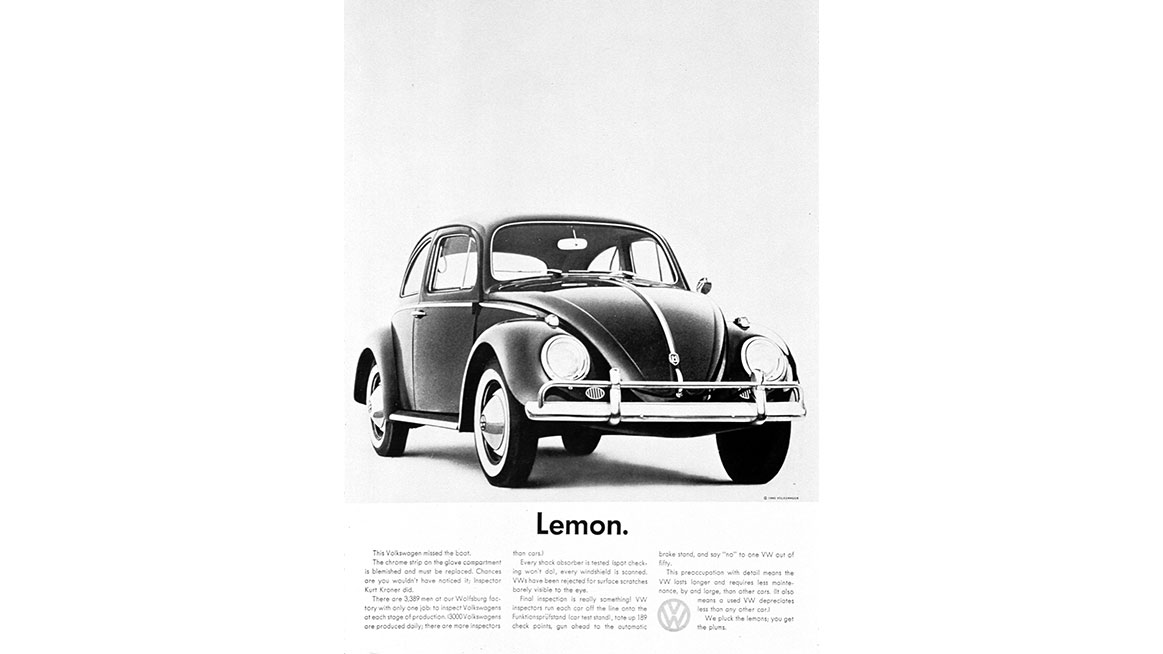
This push-pull is when creative copywriters are forced to become inventive with their words. If you can’t show the product, you have to describe the feeling of the product so vividly that the absence becomes the selling point. Think of the classic Volkswagen “Lemon” ad. Arguably one of the most famous automobile campaigns ever created. The “box” was a car that looked plain and unappealing. Instead of hiding it, they leaned into it. They used the constraint to create a narrative of obsessive quality control. When you can’t do the obvious thing, you’re forced to do the brilliant thing.
4. The Mirror: Taste vs. Conversion
There is a constant friction between what a copywriter thinks is “cool” and what actually moves the needle. You might love a cryptic, moody headline like “The Silence of the City” for a pair of noise-canceling headphones. It feels sophisticated. But if the data shows the target audience responds to “Block Out the Commute,” your taste has to take a backseat.
This creative tension is where a professional voice is forged. You learn to marry your aesthetic instincts with the cold reality of what moves the needle.
The Ego vs. The Heatmap
Take a SaaS landing page for a cybersecurity firm. The creative instinct is to go dark and metaphorical: “The Ghost in the Machine.” But the heatmap shows that users scroll right past the “poetry” to find the pricing table. The professional move isn’t to make the copy “boring”—it’s to apply your taste to the blunt reality. Instead of a cryptic metaphor, you write: “Cybersecurity So Tight, You’ll Forget It’s There.” You’ve kept the premium tone, but you’ve centered it on the user’s relief.
This balance is exactly how we approach brand voice development. We don’t just build voices that sound good in a boardroom; we build voices that work in the wild.
5. The Pivot: When to Bin the Plan
Productive chaos is knowing when to bin the plan because you’ve found something better in the wreckage. You might start with a creative brief for a “serious, corporate” whitepaper. But three hours into the research, you find a weird statistic or a bizarre customer anecdote that is ten times more compelling than the official “corporate” angle.
The tension lies in the choice: do you stick to the safe, pre-approved plan, or do you pivot? The best copywriters recognize that the brief is a map, not a set of rails. When you find a better story mid-stream, you have to be willing to tear up the outline. That pivot is where the “alive” work happens. The copy becomes more conversation and connection and less like a corporate mandate.
FAQs
Does tight timing always lead to better work?
No. There’s a tipping point where “urgent” becomes “impossible.” But 48 hours of high-focus pressure usually beats two weeks of aimless “ideation.”
How do I handle a “Box” that feels too small?
Negotiate. If the character limit is killing the message, find a way to make the limit the joke. Use the constraint as part of the copy.
Why does Copywriter Collective prioritize this friction?
Because safe work is forgettable work. We lean into the friction because that’s how you get to a brand ethos that actually sticks.

