Controversial Copywriting: When Brands Get It Wrong
In case you missed it, the internet spiraled last week. It wasn’t because of a Coldplay kiss-cam, nor was it to do with the genocide. The internet went into turmoil over a pair of jeans.
Table of Contents
Why Copywriting Still Holds Power in Marketing Campaigns
Words matter. In the world of marketing campaigns, where billions are spent convincing us to buy products and services, copywriting remains one of the most potent tools of influence. The wrong word can alienate entire communities; the right word can build an empire and when controversy erupts, it often begins with copy.
Specifically, over that cripplingly uncomfortable American Eagle ad campaign featuring the blonde-haired, blue-eyed actress, Sydney Sweeney.
The American Eagle Case: Eugenics, Wordplay and White Domination
In the current cultural climate, particularly in The U.S where racial tension, fascist rhetoric and eugenics movements discourse are back in mainstream rotation, and where Western politics and social narratives are being interrogated. Discussing eugenics movements in an ad for a pair of low-quality, fast-fashion jeans is really quite tone-deaf.
Maybe the intent was innocent. A double entendre. A throwback. Maybe the creative team was riffing on Calvin Klein’s iconic Brooke Shields campaign from the 1980s. However, Brooke Shields’ Calvin Klein script presents genetics through a detached, scientific lens, referencing evolution, selective mating and natural selection to metaphorically frame fashion as survival. It avoids personal traits, keeping the message abstract and broadly applicable.
In contrast, Sydney Sweeney’s American Eagle ad personalizes genetics, citing her inherited blonde hair and blue eyes before linking them to her “blue jeans.” While Brooke’s script flirts intellectually with eugenics movements-era language, it remains impersonal; Sydney’s evokes a more controversial, racialised subtext by visually celebrating traits historically idealized in white domination ideology.
This might be a stretch and there are many people who feel that those calling out the ad for being controversial are just overreaching. I can definitely see where that argument comes from. Especially if you interpret the ad as a simple play on the words “genes” and “jeans”. That it’s just wordplay, that the casting choice was about visuals, not ideology.
It definitely feels like they chose the slogan and wrote the script before they found the face to fit it. If that’s true, why not cast someone with blue eyes but darker features? Someone from a different background, without blonde hair. Someone whose presence wouldn’t instantly trigger political speculation about Republican affiliations. That would have taken them off the proverbial hook and spared them the controversy tied to rhetoric that inflames racial tension and hatred.
Marketing campaigns like this one should consider ethnic groups beyond just one narrow ideal. It’s not enough to simply push a product or service. Brands need to think long term, about the impact on groups of people and how to build trust within communities historically left out of the conversation, such as African Americans.
How Many Eyes See a Campaign Before It Goes Live?
Some call it Nazi propaganda. Others think the people are reading too much into it. Both arguments can be true. But what all of these marketing campaigns have in common is the roadmap they take from concept to publication. If brands want to build trust with broader groups of people, transparency and intentionality matter.
It all starts with the concept brief. This is the blueprint for any campaign. It gets distributed across every department in the marketing team so they know the goal and tone. So, the photographers receive the brief and pull together moodboards and shot lists. The graphic design team begins working on layout, fonts, and visual identity. The copywriters receive the brief and start crafting scripts, slogans, and social media captions.
To my knowledge, the brief have been made public. So we don’t know whether the American Eagle brief mentioned anything about leaning into eugenics movements. So it’s difficult to determine at what point in the process things went pear-shaped.
What we do know, however, is that the idea, whatever it may be, had to pass through a long and thorough approval chain. There are many meetings involved before a campaign gets green-lit.
The first is with the core marketing team: the CMO, director of marketing, digital and brand leads, copywriters and even assistants. Then comes a higher-level meeting where the CMO and possibly the creative director present the campaign strategy to the full C-suite: CEO, CFO; legal, PR. Once it’s approved, they pitch the concept to Sydney Sweeney’s team.
Once she’s onboard, it returns to marketing and the creative production team (whether it’s in-house or with a marketing agency) gets to work.
Copywriters write the script and the slogan. Which raises the question, did the copywriters do any research? Did they step back and read their copy with a wider lens, taking into account the current political/cultural climate in the U.S?
Then the videographer, photographer, art director, stylist, makeup and hair teams all step in. Every single person on set reads or hears that script.
Then comes post-production. Editors refine the video and voiceover. Graphic designers adjust the color grade, text overlays, transitions.
Finally, the polished campaign gets sent back to the C-suite and department heads for a final approval meeting before public release.
How many people were involved in creating this campaign? Legal, marketing, creative, sales. That’s a lot of eyes on one campaign and not one person flagged the optics? No one said, “Hey, this might be misread in 2025?”
This wasn’t an accident. It wasn’t a careless oversight. It was an intentional choice. A choice vetted and approved at every stage.
Racial Missteps in Fashion: From H&M to Desigual
This isn’t the first time copy turned controversial in the fashion industry. Let’s take a look at some other ad campaigns that couldn’t read the room.
Back in 2018, fast-fashion giant H&M faced international backlash after publishing an image of a young Black model wearing a green hoodie that read: “Coolest Monkey in the Jungle.”
If you’re not sure why that’s offensive, I’d encourage you to pause here and do some independent research. For those who are aware of the long and violent history of comparing Black people to monkeys (a tactic used in both colonial propaganda and modern racism), it’s clear why this image wasn’t just a marketing campaign blunder. It was a deeply embedded racial insult, whether intentional or not.
Unlike American Eagle’s recent Sydney Sweeney campaign, which sparked more interpretive controversy around racial coding, H&M’s hoodie ad was explicit. There was no need to “read between the lines.” It was painfully obvious. Yet, the same question arises, how did this get the green light?
H&M did respond quickly. They pulled the hoodie from U.S. stores and issued a formal apology:
“It has now been removed from all online channels and the product will not be for sale in the United States. We believe in diversity and inclusion in all that we do, and will be reviewing our internal routines.”
“Reviewing our internal routines…” That sounds familiar. As we’ve discussed before, fashion marketing campaigns, no matter how big or small, go through multiple layers of internal checks, creative reviews and approvals.
Maybe the H&M hoodie wasn’t part of a massive, multi-million-dollar campaign like “Sydney Sweeney Has Great Jeans.” Maybe it was a routine product shoot. But the same process applies:
- The hoodie was designed.
- The slogan was written.
- The product went through sample production.
- A photoshoot was scheduled.
- A team styled the model, dressed him, adjusted the lighting, framed the shot.
- A photographer captured it.
- An editor retouched the photo.
- A content manager uploaded the images onto the website.
Not to mention the multiple marketing and merchandising teams who signed off on its release.
At any one of those stages, someone could have said, “Wait, this might be a problem.”
You might argue that the phrase “Coolest Monkey in the Jungle” isn’t inherently offensive. On a blank sheet of paper, it reads as a light-hearted children’s slogan, perhaps even playful. However, placing that slogan on a Black child in a global campaign changes everything. Context is essential.
That’s the recurring issue. These aren’t isolated “mistakes.” These are systemic failures. Moments where massive corporations, made up of dozens of departments and hundreds of employees, fail to understand or care about the historical and cultural implications of the work they put out into the world.
Because let’s be honest, in 2018, this wasn’t a matter of ignorance. In 2025, it definitely isn’t. We’re not talking about a rogue intern. We’re talking about a network of professionals who either missed the racist implications or worse, just didn’t care.
So when brands like H&M and American Eagle respond with vague corporate platitudes about “diversity” and “reviewing internal processes,” we should be asking, Who exactly is in these rooms? Who’s the copywriter writing the scripts? And why are the same mistakes being made over and over again?
Let’s move on to Desigual’s “I Am Not a Doll” campaign. The fashion brand launched the ad with a woman tearing off her clothes, dancing beside mannequins, and repeating the phrase: “I am not a doll.” On the surface, it was meant to reject objectification and celebrate individuality. However, as with so many “empowerment” campaigns, the messaging missed a crucial piece of cultural nuance. Especially where the trans community is concerned.
In trans femme circles, particularly among Black and Latinx trans women, “doll” isn’t an insult, it’s a badge of honor. Born out of 1980s ballroom culture, the term represents power, femininity, sisterhood, and survival. Today, it’s still widely used within trans communities as a reclaimed identity, a protective word that signals pride and visibility. So when Desigual boldly declared “I Am Not a Doll”, at the same time activists were wearing “Protect the Dolls” tees to protest anti-trans legislation. It didn’t land as liberation, it landed as erasure.
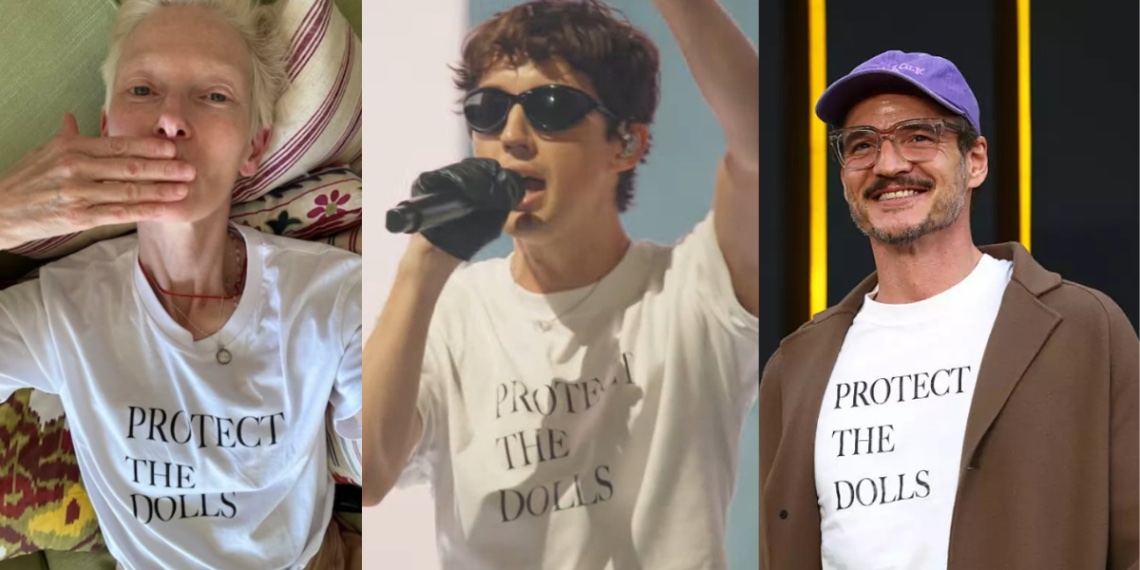 The campaign’s timing couldn’t have been worse. While the brand insisted its message was universal, the absence of any acknowledgment of trans identity or bodies in the visuals made the statement feel one-sided. To many queer and trans people, it read as a corporate slogan stripping away a term deeply rooted in trans culture. What was supposed to be a feminist rejection of commodification ended up sounding like a dismissal of trans femininity itself.
Again, how did this pass? A slogan that clashes so directly with LGBTQ+ political messaging had to go through copywriters, creative directors, stylists, editors, and marketing execs. Not one person flagged it? Not one person said, “Hey, this might hit differently in queer spaces”? When brands try to speak for all women but don’t understand which women they’re speaking over, marketing campaigns like this fall flat. What’s worse is that they alienated the very communities they claim to uplift.
Are Brands Using Controversy as a Long-Term Strategy?
On the other hand, it’s very possible these brands know the copy is controversial. Controversy sells. I forgot American Eagle existed until last week. That, combined with the fact that, in the weeks leading up to the release of the Sweeny campaign, J.P. Morgan was preparing to downgrade American Eagle stock to Underweight from Neutral (basically, American Eagle wasn’t making any money).
Fast forward to now and the whole world is talking about the brand. For some marketers, that’s the win. So regardless of how you interpret the copy, we’re all collectively being trolled by American Eagle while they’re laughing all the way to the bank. There’s no such thing as bad press, and all that.
What Copywriters and Creatives Should Do Differently
Just because controversial copy gets attention doesn’t mean it’s smart. Or responsible. Or ethical. If your marketing campaign strategy relies on ignorance, appropriation, or provocation to go viral, then the brand isn’t just out of touch, it’s the problem.
Copywriters, marketers, and creative leads must remember their responsibility. It’s not enough to sell a product or service; they must consider the historical weight and emotional resonance their language carries. When brands prioritise clicks over conscience, they lose credibility. To build trust with diverse groups of people, they need to listen, diversify their teams, consult with affected communities, and reframe their objectives from “go viral” to “do better.”
About the Author
Contact Copywriter Collective today and hire a professional fashion copywriter for your next campaign.

